


Analog Photography
Analog Photography: A Beginner’s Reference Manual

Feb
In the age of algorithmic saturation and sterile pixel perfection, analog photography for beginners is presented not as a throwback, but as a necessary reconnection with the physics of light. While the digital seeks immediacy, the chemical world invites us to participate in a ritual of patience and tangibility. Here, the image is not a binary code, but a physical imprint: a “magic” that begins in silver salt crystals and culminates in a laboratory process where the invisible becomes permanent. This beginner’s analogue photography manual has been designed to guide you through that transition from sensor to emulsion, embracing the deliberate imperfection and technical awareness that only film can demand.
1. Why go back to the reel in the age of the pixel?
Venturing into the chemical world offers benefits that digital automation has diluted. As specialists, we argue that technical limitation is, paradoxically, the greatest engine of creativity. Here are the fundamental reasons:
- Drastic reduction in editing time: In the digital stream, we spend hours in front of a screen correcting colors. In analogue, chromatic personality is “cooked” into the chemistry of the film. The laboratory delivers a result with an organic grain and color that is difficult to replicate artificially.
- Aesthetic differentiation: In a market saturated with flat images, the subjective nature of film—its texture, its latitude of exposure, and its response to color—allows your work to stand out for its authenticity.
- Improvement of photographic technique (Reflection): The lack of immediacy is your best teacher. Not being able to check the screen after each shot, you are forced to view the photo before taking it. Analog photography for beginners teaches that every shot is an investment of time and resources, which sharpens observation.
- Access to legendary optics: For the price of a basic digital lens, today you can acquire professional-quality mechanical bodies and lenses that defined the aesthetics of the twentieth century.
- The mystique of the process: Waiting transforms the photographic act. From loading the roll to receiving the negatives, there is a sensory connection to the physical object that the RAW file can never match.
2. The first dilemma: SLR or Rangefinder?
Choosing your tool will define not only how you see, but how you interact with the environment. Vision mechanics are at the heart of this distinction.
| Feature | SLR (Single-Lens Reflex) | Rangefinder |
| Vision Mechanism | Through the lens (mirror/pentaprism) | Independent side optical window |
| Focus System | Microprisms / Split image on screen | Center Split Image Patch |
| Framing Accuracy | 100% real (what you see is what you get) | Subject to parallax error at short distances |
| Shutter Noise | Audible (clack mirror) | Near silent (curtain/center shutter) |
| Size/Weight | More robust and bulky | Compact, slim and discreet |
| Ideal Uses | Macro, Telephoto, Precision Portrait | Street photography, travel, documentary |
The mirror system vs. the optical patch
In an SLR, light travels through the lens, bounces off a mirror to a pentaprism, and reaches your eye. When shooting, the mirror lifts (causing the viewfinder to turn off momentarily). This system is ideal for learning, as it allows you to preview the depth of field.
In a rangefinder, the viewer is a direct window. Focusing is achieved by aligning two images in a central “patch” using a system of coupled mirrors. Its great advantage is that it allows you to see “out of frame”, anticipating elements that are about to enter the scene, although it suffers from parallax error: at short distances, what the viewfinder sees does not coincide exactly with what the lens sees due to its physical displacement.
If all this sounds too technical to you or you’re too lazy to deal with complex settings and labs, this doesn’t have to hold you back. At Swiss+Go we have cameras designed to get you started in analogue photography without any headaches: from complete packs to reusable options, and even very simple disposable models.
These ready-to-use, semi-automatic analog cameras allow you to focus on shooting and enjoy the analog aesthetic without having to master all the technical concepts of traditional film at once.
Recommended Products
-
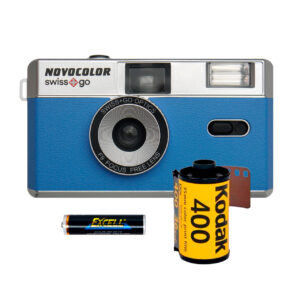
Swiss+go Novocolor 35mm Blue Analog Camera Pack with Flash |…
Original price was: 59,90€.44,90€Current price is: 44,90€. -
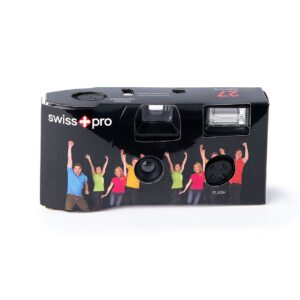
swiss+go Disposable Camera 400-27 with Flash | 27 Photos |…
Original price was: 26,30€.14,90€Current price is: 14,90€. -
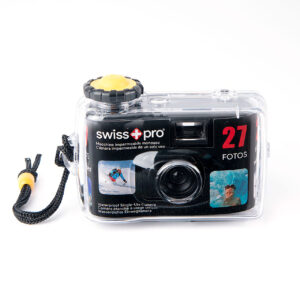
swiss+pro 400/27 Sport – 35mm waterproof disposable camera
Original price was: 29,50€.19,90€Current price is: 19,90€. -
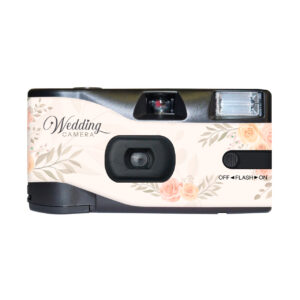
Swiss+go Wedding 400-27 Disposable Camera with Flash | Wedding Events…
30,20€
3. The Soul of the Photo: Beginner’s Guide to Reels
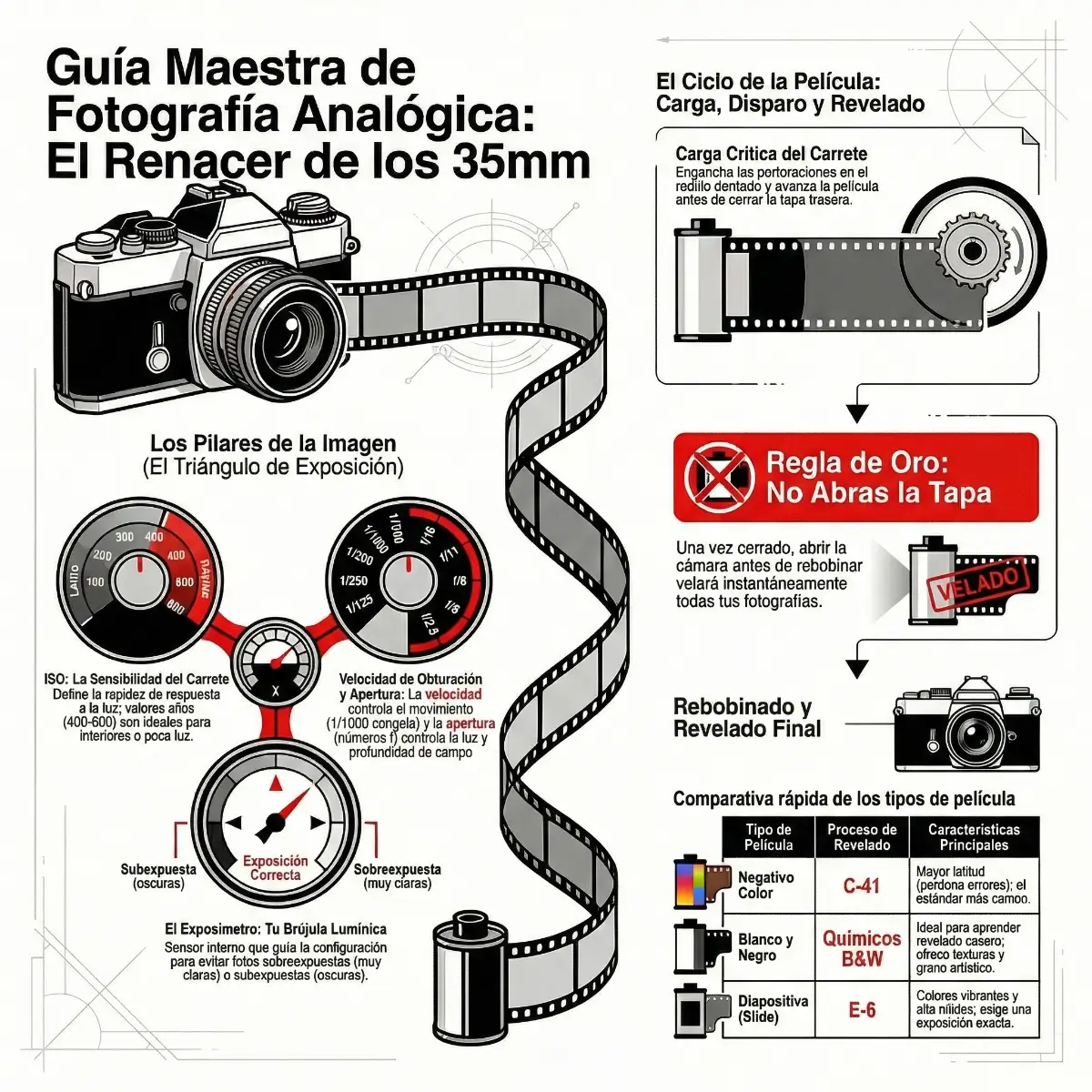
The choice of film is the most important creative decision. This analog photography reference manual for beginners emphasizes that the support defines the structure of the final image.
Color vs. Color Black and White: The Chemistry Behind It
- Color (C-41 Process): It’s the industry standard. Films like the Kodak Gold 200 or Kodak Color Plus 200 offer warm tones, with a generous exposure latitude that forgives beginner’s mistakes. The Fuji Color C200, on the other hand, stands out for its teal greens and cooler tones, ideal for landscapes.
- Black and White (Traditional Process): Here silver is the protagonist. Films such as Kodak Tri-X 400 or Ilford HP5 are legends for their marked grain and contrast. Shooting in black and white forces you to “think textures and contrasts”, ignoring color to focus on pure composition and light.
Basic vs. Range Professional
For those who are just starting out, “entry-level” films (Color Plus, Gold) are ideal because of their low cost. However, professional brands such as Kodak Portra or Ektar offer what laboratories call Fine Grain (ultra-fine grain) and an ability to retain information in the highlights (dynamic range) far superior to any digital sensor.
4. The Exposure Triangle in the Physical World
Mastering exposure in analog requires understanding that we are working with sensitive matter, not with electrical signals.
- ISO/ASA (Fixed Sensitivity): Unlike digital, here ISO is a chemical property of the film. If you load an ISO 400, the entire roll shoots up to 400. ISO 100/200 (slow) films require a lot of light and offer fine grain; those of ISO 400/800 (fast) are all-terrain for indoors or cloudy days.
- Opening (f-numbers): It works exactly like the human iris. An f/2 (large aperture) lets in a lot of light and creates a blurred background (bokeh). An f/16 (small aperture) closes the light passage but increases the depth of field, keeping everything sharp.
- Shutter Speed: Controls exposure time in fractions of a second (1/1000, 1/125). Bulb Mode (B) is essential for long exposures: the shutter stays open as long as you hold down the shutter button, allowing you to capture traces of light at night.
“Latent images are usually referred to as all those supported on a plate or film, which will only become visible in contact with a revealing chemical solution.” — UNAM Thesis.
5. Step-by-Step Operation: Load and Shoot
As a lab technician, I’ve seen hundreds of rolls lost due to improper loading. Follow this mechanical procedure:
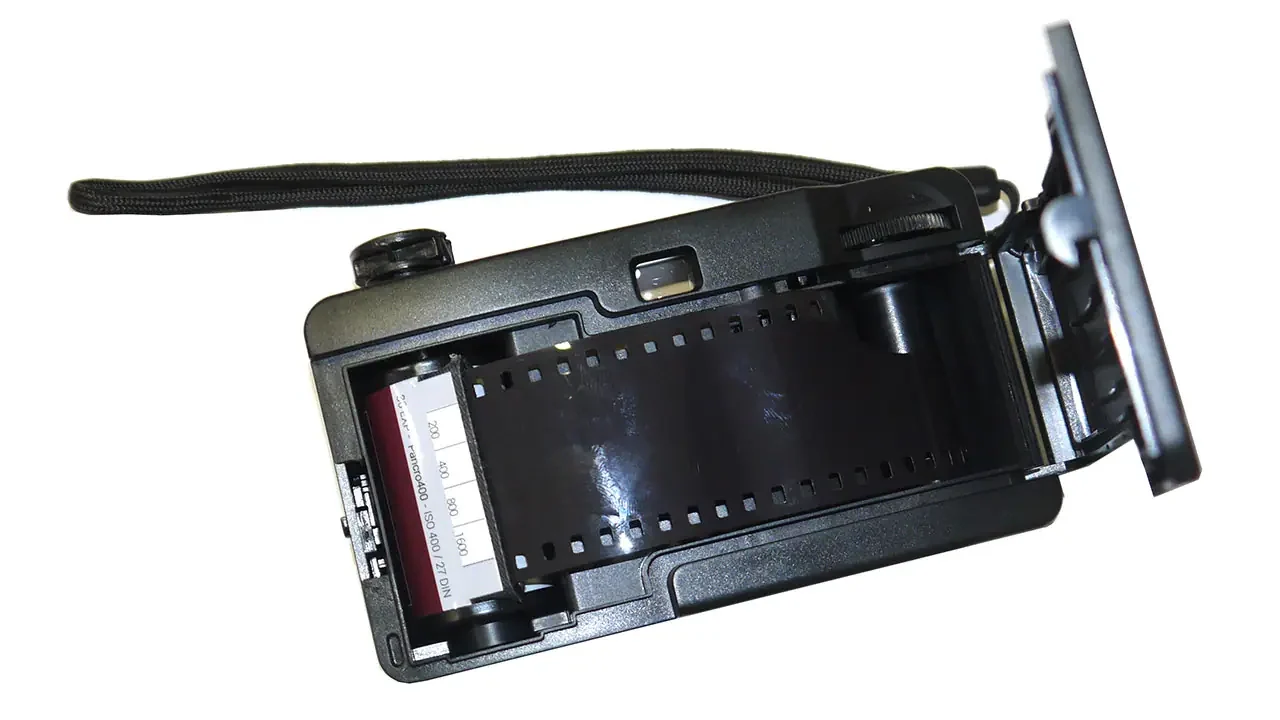
- Safe Charging: Pull the rewind lever up to open the lid. Insert the spool to the left with the pivot facing down.
- The critical hook: Pull the tab up to the drag reel (right). Make sure that the teeth of the mechanism (sprockets) fit perfectly into the perforations of the film.
- Spin Verification: Before closing, advance the lever and fire once. If the movie progresses, close the lid. The first fatal error: If after closing the lid and advancing the lever you do not see that the rewind crank (left) rotates, the film is not engaged. You will shoot the whole roll “into the air”.
- Photometer reading: Most cameras use needles or lights (LEDs). You should adjust aperture or speed until the marks line up. Remember that they are center-weighted measurement systems; they give priority to what is in the middle of the frame.
6. The mistakes every beginner makes (and how to avoid them)
- Accidental veiling: Never open the back cover without rewinding. If it does, close it in a second. You’ll lose the current photo and the previous two, but the rest of the roll is protected by the tension of the layers.
- The forgotten ISO dial: After loading, immediately set the camera’s ISO dial. If you shoot a 400 roll set to 100, you’ll massively overexpose the photos.
- The Glowing Background Deception: If you photograph someone in front of a window, the light meter will be “scared” by the backlight and leave the subject dark (underexposure). Use a neutral gray chart or measure the light in the palm of your hand (which has a similar reflectance to medium gray) to get the correct exposure of your face.
- UV filters as safe: In analogue, UV filters not only protect the lens lens from shock; They also prevent unwanted bluish tones in old films sensitive to ultraviolet radiation.
7. End of Roll: Rewinding and Lab
When the drag lever offers unusual resistance, don’t force it: you’ve reached the end of the support.
- Release button: It’s vital to press the small button on the base of the camera. If you don’t and turn the crank, you’ll break the film.
- Feel the tension: Turn the rewind crank clockwise. You will notice resistance until you hear a characteristic “clack” ; This is the moment when the film is released from the drag reel.
- Final destination: The lab can give you the developed negative (the physical original) and digital files (scanned). My advice: always ask for the negatives; They are your “master file” for the future.
8. The “Magical” World of the Darkroom: Chemistry of Developing
To understand photography, we must understand the structure of the film. A black and white negative is made up of six critical layers: Antistatic, Antihalo (which prevents internal reflections), Support (acetate), Substrate (adhesive), Sensitive Layer (silver halides) and Anti-abrasive.
The traditional chemical process is governed by three main baths at a strict temperature of 20°C:
- Developer: It uses agents such as hydroquinone to convert exposed silver halides into black metallic silver, making the latent image visible. Stirring is crucial here to renew the chemical in contact with the emulsion.
- Stop Bath: Usually an acetic acid solution. Its function is to instantly stop the alkalinity of the developer, preventing the image from becoming saturated or veiled.
- Fixer: Based on sodium thiosulfate or ammonium. Dissolves unexposed silver halides. Without this step, the film would still be sensitive and turn black when it came to light.
Lab Tip: To preserve your chemicals, store them in bellows bottles or use the marbles trick: add glass marbles to the jar to raise the liquid level to the rim, removing air and preventing oxidation.
9. Summary and final reflection
Analogue photography is an exercise in technical humility. It teaches us that perfection does not lie in the absence of errors, but in the conscious control of them. At the end of the day, this art is the perfect combination of the precision of optics and the unpredictability of chemistry.
Every time you press the shutter button, you’re creating a unique physical object, a slice of time trapped in silver. Every photo counts because every shot costs; It costs patience, it costs money, and it costs intention. This manual is the map, but the territory is discovered by walking.
Do you have an old camera inherited from your grandparents in a drawer or have you seen a mechanical jewel in a flea market? It’s time to dust it off, load your first roll and rediscover, frame by frame, your way of observing the world.
